E-mail Us: market1@hotoheat.com Call Us On: +86-15366416606

- All
- Product Name
- Product Keyword
- Product Model
- Product Summary
- Product Description
- Multi Field Search
Views: 0 Author: Site Editor Publish Time: 2026-07-14 Origin: Site
Precise, reliable inline water heating drives industrial processes, facility winterization, and temperature maintenance. When fluid temperatures drop below operational thresholds, viscosity changes, chemical reactions stall, and unprotected pipes freeze. Specifying the right heating equipment demands rigorous engineering and a deep understanding of fluid dynamics and thermodynamics.
Improper specification carries heavy operational risks. Mismatched watt densities, incorrect material choices, and poor installation layouts inevitably lead to rapid scale accumulation, sheath failure, and unplanned downtime. A heater that burns out prematurely disrupts operations, damages downstream equipment, and creates severe safety hazards on the plant floor.
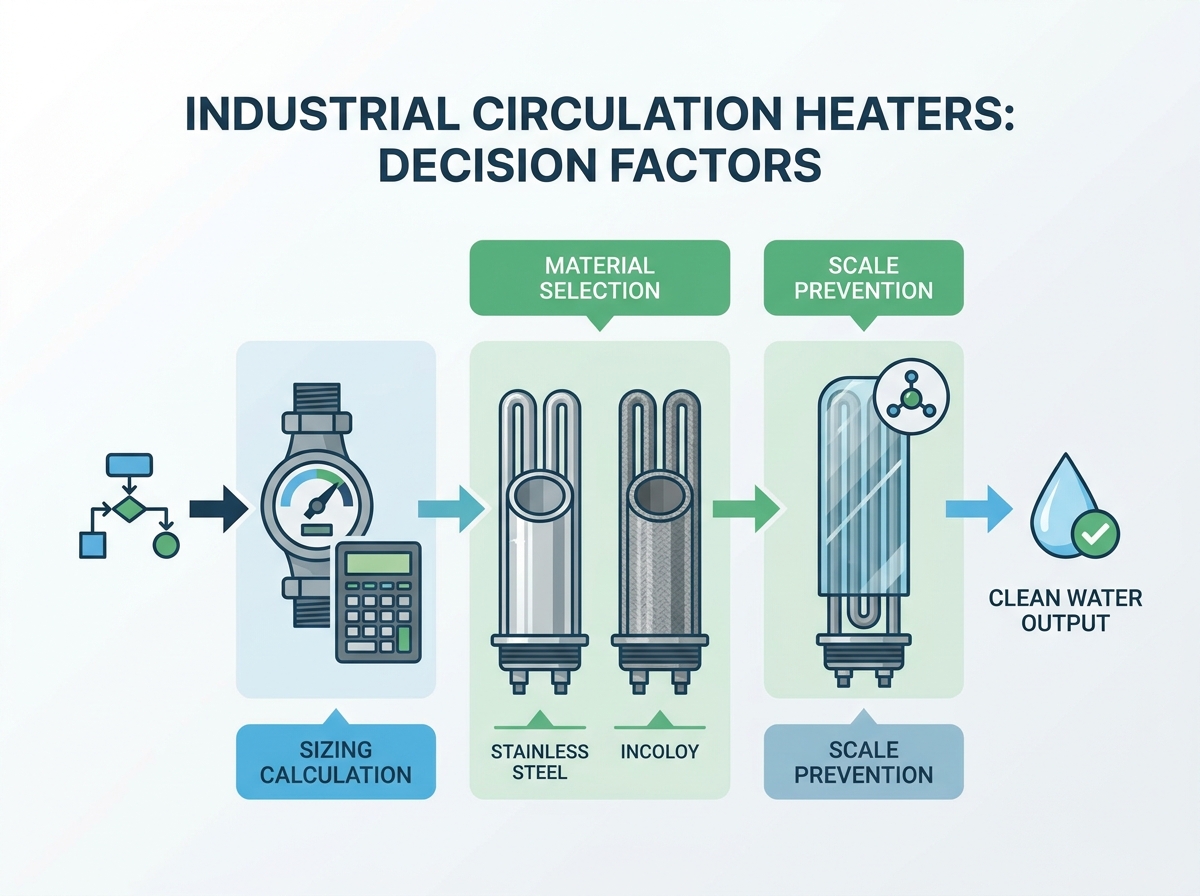
This guide establishes the engineering framework for evaluating and specifying industrial circulation heaters for water heating. We focus strictly on thermodynamic sizing, metallurgical compatibility, and proactive scale mitigation to ensure long-term reliability, optimal thermal performance, and continuous operation in demanding environments.
Watt Density is Critical: Clean water applications typically require watt densities between 45–65 W/in²; exceeding this accelerates scale formation and reduces element lifespan.
Material Compatibility Dictates Longevity: Sheath and vessel materials must be matched to specific water chemistry (e.g., municipal vs. deionized water) to prevent galvanic corrosion and pitting.
Flow Velocity Impacts Performance: Proper baffle design and flow rate calculations are necessary to maintain uniform heat transfer and prevent localized boiling or pressure drops.
Orientation and Venting Matter: Mounting configurations (vertical vs. horizontal) influence trapped air elimination, sediment buildup, and overall thermal efficiency.
Controls Drive Efficiency: Integrating SCR (Silicon Controlled Rectifier) panels rather than basic contactors minimizes temperature overshoot and extends heater life.
The term clean water encompasses several distinct fluid types, each fundamentally altering the technical requirements of a circulation heater. Municipal or tap water contains dissolved minerals like calcium and magnesium. These minerals precipitate out at high temperatures, forming hard scale on heating elements. Process water often contains trace chemicals, rust inhibitors, or particulates depending on the closed-loop system design. Highly purified water, such as reverse osmosis (RO) or deionized (DI) water, lacks ions entirely. This makes it highly aggressive; it will strip ions from surrounding metals, demanding specialized, passivated alloys to prevent rapid degradation.
Water Type | Characteristics | Primary Heater Risk | Recommended Sheath Material |
|---|---|---|---|
Municipal / Tap Water | Contains calcium, magnesium, and chlorides. | Rapid scale accumulation and localized overheating. | Incoloy 800 or 840 |
Treated Process Water | Closed-loop, often contains glycol or inhibitors. | Sludge buildup or chemical degradation over time. | Copper or Incoloy |
Deionized (DI) / RO Water | Highly purified, zero mineral content, ion-hungry. | Aggressive galvanic corrosion and metal pitting. | Passivated 316L Stainless Steel |
Engineers must address distinct regulatory and engineering requirements based on the specific application. Domestic or potable hot water systems require specific sanitization temperatures, typically maintained between 120°F and 140°F, to prevent Legionella bacteria growth. These systems also demand NSF or FDA compliance for all wetted components to ensure human safety. High-temperature industrial process water systems operate under different constraints. They prioritize rapid heat transfer, high-pressure containment, and continuous duty cycles over sanitary standards.
Success in inline water heating is defined by achieving the required Delta T (ΔT) at specific flow rates, measured in gallons per minute (GPM), while maintaining acceptable pressure drop limits across the vessel. If the pressure drop is too high, pump strain increases, leading to premature pump failure and reduced system flow. If the flow is too low, the heater risks localized boiling, cavitation, and rapid element burnout due to poor heat dissipation.
Industrial heating equipment must meet stringent safety certifications. You must distinguish between ASME Section IV, which governs heating boilers and potable water systems operating at lower pressures, and ASME Section VIII, which applies to unfired pressure vessels handling industrial process fluids at high pressures and temperatures. Additionally, UL or CSA listings ensure the electrical components, terminal enclosures, and wiring meet rigorous safety standards for industrial environments.
Accurate sizing begins with strict thermodynamic calculations. The baseline formula for water heating determines the raw power needed to raise the fluid temperature at a specific flow rate. You must calculate and offset heat loss through the vessel walls, connected piping, and the ambient environment to ensure the system delivers the target temperature at the outlet.
Follow these steps to determine the exact kW requirement:
Determine the exact flow rate in Gallons Per Minute (GPM).
Calculate the Delta T (ΔT) by subtracting the incoming water temperature from the desired outlet temperature.
Apply the standard thermodynamic formula: kW = (GPM × ΔT × 0.146) / Efficiency Factor.
Calculate surface heat loss from the uninsulated or insulated vessel based on ambient air temperature.
Add a 10% to 20% safety factor to the final kW total to account for voltage fluctuations and long-term element degradation.
When specifying heaters for outdoor winterization, the kW sizing requires significant adjustment. Calculations must factor in the lowest expected ambient temperatures, maximum wind velocity, and the specific R-values of the insulation used on the vessel and surrounding piping. Undersizing in these applications leads to frozen lines, ruptured pipes, and catastrophic system failures during severe weather events. Always size freeze protection systems for the absolute worst-case historical weather data for the installation site.
Watt density, expressed as watts per square inch (W/in²), measures the heat output relative to the surface area of the heating element. For clean water, the engineering standard is 45–65 W/in². Derating, or lowering the watt density to 20-30 W/in², is mandatory in high-mineral hard water areas or low-flow conditions. Lower watt densities spread the heat over a larger surface area, reducing the sheath temperature and significantly slowing the rate of mineral precipitation and scale buildup.
The physical dimensions of the heater vessel and its internal baffle arrangements directly dictate fluid velocity and heat transfer efficiency. Baffles force the water to flow across the heating elements in a serpentine, turbulent pattern. This turbulence maximizes heat absorption and prevents stagnant zones. Proper baffle configuration also manages pressure drop. Engineers must calculate the exact baffle cut percentage and spacing to ensure the system operates within the facility's existing pump capacities without causing excessive backpressure.
Installation orientation significantly impacts thermal performance, venting requirements, and long-term maintenance procedures.
Vertical Mounting: This orientation saves valuable floor space in crowded mechanical rooms. However, it requires proper venting at the highest point. Air pockets naturally form at the top terminal enclosure. If not continuously bled, these air pockets expose the upper portions of the heating elements, leading to dry-firing, rapid overheating, and immediate failure.
Horizontal Mounting: This setup minimizes the risk of trapped air pockets, making it inherently safer for the elements. However, horizontal vessels are more susceptible to sediment and scale accumulation on the bottom elements, particularly under low-flow conditions. This requires regular blowdown maintenance to flush out accumulated debris.
Selecting the correct sheath material dictates the operational lifespan of the heater. Using the wrong alloy guarantees premature failure.
Copper: Cost-effective for basic, non-corrosive clean water heating and light freeze protection in closed-loop systems. It transfers heat exceptionally well but degrades quickly in oxygen-rich or acidic environments.
Incoloy 800 and 840: These high-nickel alloys provide superior resistance to scaling, stress corrosion cracking, and high-temperature oxidation. Incoloy is the standard, reliable choice for municipal water, hard water, and demanding industrial process applications.
Stainless Steel 304 and 316L: Mandatory for deionized (DI) or reverse osmosis (RO) water. These purified waters aggressively attack copper and carbon steel. Passivated stainless steel resists this ion-stripping action, maintaining system integrity and preventing fluid contamination.
The vessel and flange materials must perfectly match the application and the fluid chemistry. Carbon steel is the standard, economical choice for closed-loop, treated, non-corrosive water systems where oxygen levels are strictly controlled. Stainless steel is required for sanitary applications, food-grade processes, or highly oxygenated and purified water systems to prevent rust, particulate shedding, and contamination of the process fluid.
The terminal enclosure protects the sensitive electrical connections, wiring, and contactors from the surrounding environment. Selecting the wrong enclosure leads to electrical shorts and severe safety hazards.
NEMA Rating | Environmental Application | Protection Level |
|---|---|---|
NEMA 1 | General Indoor | Protects against dust and light debris. No moisture protection. |
NEMA 4 | Outdoor / Washdown | Watertight, dust-tight, protects against hose-directed water. |
NEMA 4X | Corrosive Environments | Same as NEMA 4, plus superior corrosion resistance (usually stainless steel or fiberglass). |
NEMA 7 | Hazardous Locations | Explosion-proof, designed to contain internal explosions without igniting external gases. |
Scale forms when calcium carbonate, magnesium, and other dissolved solids precipitate out of the water at high sheath temperatures. This creates a hard, rock-like insulating layer directly on the heating elements. This insulation blocks heat transfer into the fluid. Consequently, the internal resistance wire temperature rises drastically to compensate. Eventually, the internal temperatures exceed the melting point of the dielectric insulation or the sheath itself, causing the element to split, short out, and fail.
Proactive scale mitigation starts during the initial engineering phase. Combining lower watt densities with optimized fluid velocities creates turbulent flow across the element bundle. This mechanical turbulence naturally sweeps minerals away from the elements before they can bake onto the sheath surface. Proper baffle design ensures this velocity is maintained evenly across the entire length of the heater.
Robust safety interlocks are non-negotiable for industrial heating systems. Systems must include high-limit thermocouples welded directly to the element sheath, low-water cutoffs, and inline flow switches. These devices instantly de-energize the contactors if flow drops below critical thresholds or if sheath temperatures spike. This prevents instantaneous scaling, fluid boiling, and catastrophic element burnout during pump failures or valve closures.
A realistic, strictly enforced preventative maintenance schedule prevents unexpected downtime. Facilities must implement routine system flushing and chemical descaling procedures based on local water hardness and duty cycles.
Isolate the heater from the main process line using lockout/tagout procedures.
Drain the vessel completely using the bottom blowdown valve to remove loose sediment.
Circulate a manufacturer-approved chemical descaling solution through the vessel to dissolve hardened calcium deposits.
Flush the vessel thoroughly with clean water to neutralize any remaining acid.
Perform megger testing on the elements to detect any degradation in the dielectric insulation before re-energizing the system.
Selecting an industrial circulation heater for water heating requires more than simply matching a required kilowatt rating. Long-term reliability depends on how well the entire heating system is engineered around real operating conditions, including flow rate, temperature rise, water chemistry, material compatibility, and scale control requirements.
A properly designed heater maintains efficient heat transfer while keeping sheath temperatures, pressure drop, and corrosion risks within acceptable limits. Choosing the correct watt density, optimizing internal flow paths, and integrating reliable safety controls can significantly extend element life and reduce unexpected maintenance costs. In contrast, overlooking these factors often results in scale buildup, premature element failure, and avoidable production interruptions.
Every industrial water heating application has unique operating challenges. Factors such as municipal water quality, closed-loop process conditions, outdoor installation requirements, and continuous-duty operation all influence the ideal heater configuration. Working with an experienced manufacturer helps ensure the final solution is not only correctly sized but also optimized for long-term performance and reliability.
A: The industry standard for clean water is 45–65 W/in². Lower densities, typically 20-30 W/in², are required for applications involving high water hardness or low flow rates to prevent rapid scaling and premature element failure.
A: Use the standard thermodynamic formula: kW = (GPM × ΔT × 0.146) / Efficiency Factor. You must also calculate and add the surface heat losses through the vessel, piping, and outdoor environments to ensure accurate sizing.
A: DI water is highly purified and lacks ions. It acts aggressively to strip ions from surrounding metals, causing rapid galvanic corrosion and pitting in carbon steel and copper. Passivated stainless steel is mandatory to resist this attack.
A: Proper fluid velocity, dictated by pump size and internal baffles, ensures turbulent flow. This turbulence maximizes heat transfer efficiency, prevents localized boiling, and mechanically sweeps minerals away to prevent scale buildup.
A: Vertical mounting saves floor space but requires strict venting protocols to prevent air pockets and dry-firing. Horizontal mounting minimizes air pockets but requires regular blowdown maintenance to manage sediment buildup on the bottom elements.
A: Essential safety devices include high-limit thermocouples attached to the sheath, inline flow switches, and low-level cutoffs. These instantly de-energize the heater if flow stops or fluid levels drop below the elements.
A: Maintenance frequency depends entirely on water hardness, operating temperature, and duty cycle. High-mineral applications require frequent chemical descaling and flushing, sometimes quarterly, while closed-loop treated systems may only need annual inspections.