E-mail Us: market1@hotoheat.com Call Us On: +86-15366416606

- All
- Product Name
- Product Keyword
- Product Model
- Product Summary
- Product Description
- Multi Field Search
Views: 0 Author: Site Editor Publish Time: 2026-07-24 Origin: Site
Thermal variance in food processing operates on a strict zero-tolerance policy. Even minor temperature fluctuations during pasteurization, baking, or sterilization cause batch spoilage, compromise safety, and trigger regulatory failures. Relying on manual temperature monitoring, outdated mechanical relays, or fragmented process controllers introduces severe operational risks. These outdated methods force high labor costs, produce inconsistent product quality, and leave facilities vulnerable during safety audits.
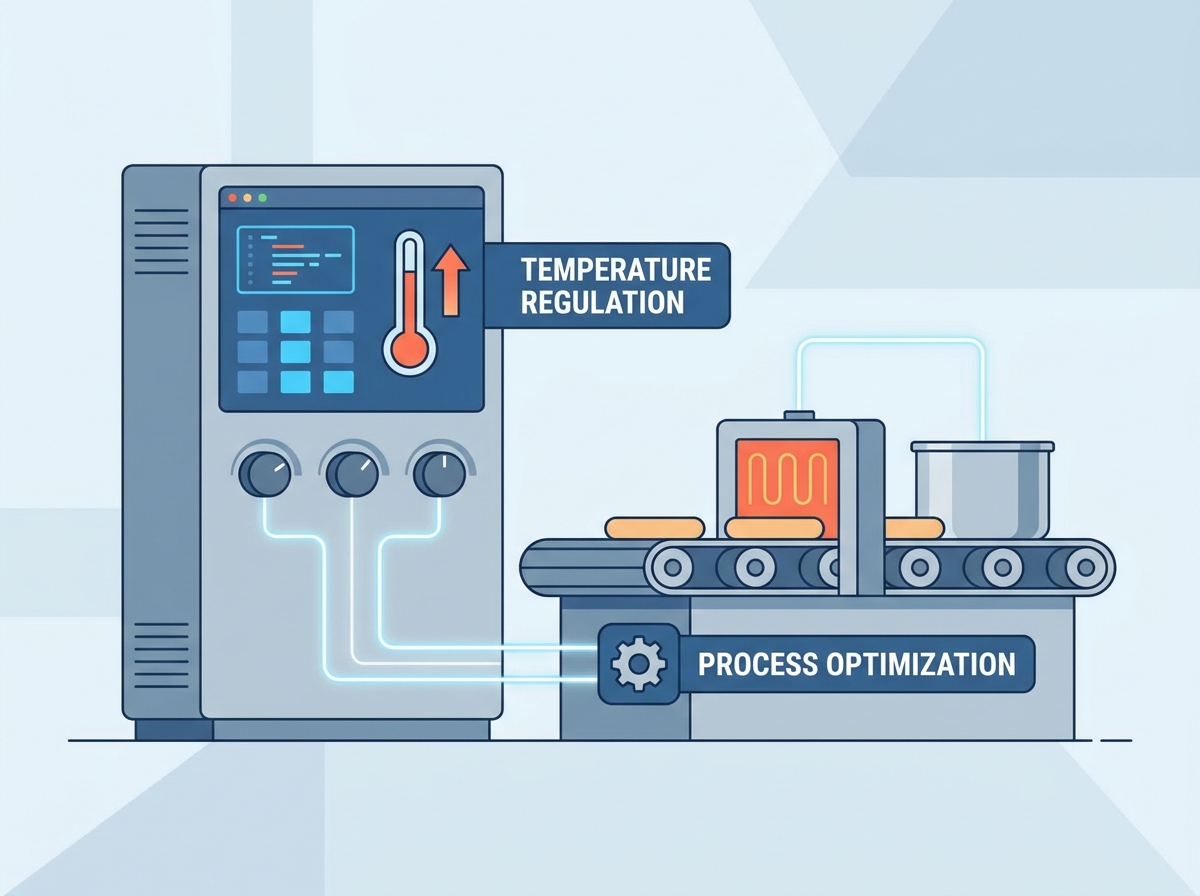
To eliminate these risks, plant managers must transition to centralized, automated solutions. Upgrading to industrial heater control panels provides the exact thermal setpoints required for strict compliance while optimizing energy consumption across complex production lines. By automating thermal management, facilities maintain consistent product quality, reduce human error, and ensure strict adherence to food safety standards without relying on constant operator intervention.
Automated Consistency: Industrial heater control panels eliminate manual oversight by utilizing advanced process controllers to maintain exact temperature setpoints across heating, boiling, and sterilization phases.
Regulatory Compliance: Properly specified panels support HACCP and FDA requirements through continuous data logging, precise thermal calibration, and washdown-ready enclosures.
System Integration: Modern control panels integrate seamlessly with existing SCADA systems, providing facility-wide visibility into temperature and liquid level controls.
Risk Mitigation: Upgrading to centralized control reduces the risk of thermal overshoot, equipment burnout, and costly production downtime.
Effective thermal management in food processing requires rapid heat-up times, zero thermal overshoot, sustained holding temperatures, and tight tolerance bands. Achieving these success criteria demands a robust system capable of reacting instantly to process changes. Without precise control, food products risk undercooking, burning, or failing to meet critical sterilization thresholds. Operators cannot manually adjust valves and switches fast enough to maintain the narrow temperature bands required by modern food safety regulations.
A single control panel centralizes process control by consolidating inputs from multiple sensors, including temperature, pressure, flow, and liquid level. This centralization allows the panel to orchestrate heaters, pumps, and valves simultaneously, ensuring all components work in harmony. By eliminating operator dependency, automated systems shift the burden of temperature regulation from human operators to algorithmic controllers. This reduces human error rates and frees up floor labor for other tasks.
Modern panels excel in multi-loop process orchestration. They manage multiple independent heating and cooling zones from a single interface. This capability ensures uniform thermal distribution in large-scale operations, preventing localized hot or cold spots that compromise product integrity. When managing a 50-foot baking oven, for example, the panel independently modulates power to different heating zones to account for the cold product entering the front and the moisture loss occurring near the exit.
Control Method | Response Time | Accuracy | Operator Dependency | Data Logging |
|---|---|---|---|---|
Manual Control | Slow (Minutes) | Low (±10°F) | High | Manual Clipboards |
Basic Thermostat | Medium (Seconds) | Moderate (±5°F) | Medium | None |
Automated Control Panel | Instant (Milliseconds) | High (±1°F) | Zero | Continuous/SCADA |
Dairy, beverage, and canned goods production require strict time-temperature adherence to ensure consumer safety. High-Temperature Short-Time (HTST) pasteurization demands that milk reaches exactly 161°F and holds that temperature for 15 seconds. Control panels ensure continuous holding temperatures without dropping below critical safety thresholds. If the temperature drops even a fraction of a degree, the panel automatically triggers a flow diversion valve to send the product back for reprocessing, preventing microbial survival and ensuring regulatory compliance.
High-temperature applications present unique challenges regarding thermal recovery times. When cold raw materials enter hot oil or industrial ovens, the temperature drops rapidly. The control panel modulates power to the heating elements, ensuring rapid recovery and maintaining consistent cooking profiles. This prevents uneven cooking and ensures a uniform final product.
Cold product enters the frying vat, causing an immediate temperature drop.
The RTD sensor detects the drop and sends a low-voltage signal to the panel.
The PID controller calculates the required power output to recover the temperature.
Solid State Relays fire, delivering maximum power to the immersion heaters.
As the oil approaches the setpoint, the panel tapers the power to prevent overshoot.
Vats, mixing tanks, and waste treatment tanks require the integration of temperature and liquid level controls. Control panels prevent the dry-firing of immersion heaters by interlocking temperature outputs with liquid level sensor inputs. If the liquid level drops below a safe threshold, the panel automatically cuts power to the heaters, preventing equipment damage and potential fire hazards. This interlock is a non-negotiable safety feature in any tank heating application.
Heater control panels regulate temperature within jacketed chemical or food reactors and steam boilers, ensuring optimal reaction conditions. Furthermore, they optimize Clean-in-Place (CIP) sanitization cycles. By maintaining exact chemical-wash temperatures, control panels eliminate microbial risks without wasting energy. A typical CIP cycle requires a caustic wash at 180°F. The panel ensures the water heater delivers exactly 180°F water to the spray balls, ensuring equipment is thoroughly sanitized and ready for the next production run.
Basic on/off thermostats suffer from severe limitations, including frequent cycling, significant temperature swings, and accelerated mechanical wear. Proportional-Integral-Derivative (PID) control offers a mathematical advantage by anticipating heat demand. PID controllers stabilize process variables and minimize thermal overshoot, ensuring the temperature remains tightly bound to the desired setpoint. Instead of simply turning a heater on at 149°F and off at 151°F, the PID controller calculates the rate of temperature change and applies proportional power to hold exactly 150°F.
Advanced PID controllers within industrial heater control panels manage dual outputs to control both heating elements and cooling media, such as chilled water, fans, or glycol jackets. This capability supports exothermic food reactions or rapid-cooling food preservation steps, where precise temperature modulation in both directions is required. The controller seamlessly transitions from firing the electric heaters to opening a chilled water solenoid valve to maintain the exact setpoint.
Food-grade applications rely on accurate sensor data. Resistance Temperature Detectors (RTDs) offer superior accuracy and stability over time compared to standard thermocouples. Thermocouples provide faster response times in certain high-temperature environments, but RTDs remain the standard for sanitary food applications. The control panel processes these low-voltage sensor signals to dictate the precise power output required to maintain the setpoint.
Sensor Type | Accuracy | Temperature Range | Durability | Best Application |
|---|---|---|---|---|
RTD (PT100) | High (±0.1°C) | -200°C to 600°C | Moderate | Sanitary liquid heating, CIP |
Type J Thermocouple | Moderate (±2.2°C) | 0°C to 760°C | High | Industrial ovens, baking |
Type K Thermocouple | Moderate (±2.2°C) | -200°C to 1260°C | High | High-temp roasting, fryers |
Control panels utilize different output types to manage heaters. Digital outputs involve voltage pulses and mechanical relay switching, suitable for basic applications. Analog outputs, such as 4-20mA or 0-10V signals, provide proportional control. This allows for infinite resolution, enabling infinitely variable heater output for the most precise temperature regulation. When paired with an SCR power controller, a 4-20mA signal allows the panel to deliver exactly 43% power to a heater, rather than just 0% or 100%.
Modern panels have shifted from mechanical contactors to Solid State Relays (SSRs) or Silicon Controlled Rectifiers (SCRs). SSRs and SCRs offer infinite resolution, lack moving parts, and boast a significantly longer lifespan. They operate quietly and provide precise power metering to the heaters, improving overall system efficiency and reliability. Mechanical contactors wear out after a few hundred thousand cycles, whereas SSRs can cycle millions of times without degradation.
Food processing environments face harsh chemical washdowns, high humidity, and high-pressure spray. Therefore, NEMA 4X or IP66/IP69K rated enclosures are necessary to protect the internal electronics. Material selection is equally important. Using 304 or 316 stainless steel prevents corrosion, oxidation, and bacterial harborage, ensuring the panel remains sanitary and functional. A standard painted steel enclosure will rust within months in a meat processing facility, leading to electrical shorts and health code violations.
To tie the local heater control panel into the facility's overarching SCADA or Distributed Control System (DCS) network, specific communication protocols like Modbus TCP, Ethernet/IP, or Profinet are required. Remote monitoring and centralized data logging are essential for compliance audit trails, specifically meeting FDA 21 CFR Part 11 requirements for electronic records. Plant managers need the ability to pull historical temperature data instantly during an FDA audit.
Essential safety integrations protect both the equipment and the facility. These include high-limit temperature controllers, emergency stop (E-stop) circuits, phase loss protection, and ground fault protection. Independent safety contactors are critical. They prevent catastrophic runaway heating failures if the primary switching device, such as an SSR, shorts out in the closed position. The high-limit controller operates on a completely separate sensor and circuit, ensuring a fail-safe shutdown.
Replacing legacy control systems carries the risk of prolonged production halts. To mitigate this, facilities must require vendors to provide comprehensive wiring schematics, pre-programmed controllers, and factory acceptance testing (FAT) prior to installation. This ensures the new panel is plug-and-play ready, minimizing installation time and production disruption. A well-executed retrofit should take hours, not days.
Over time, sensors degrade or drift, causing the panel to maintain an incorrect actual temperature despite showing the correct setpoint. Additionally, out-of-tune PID parameters cause temperature oscillation. Establishing strict, documented calibration schedules is vital. Facilities should utilize panels featuring sensor break detection and deviation alarms, and deploy controllers with auto-tuning capabilities to automatically optimize control loops.
Perform monthly single-point calibration checks using a certified reference thermometer.
Run the PID controller's auto-tune function whenever process variables change significantly.
Replace RTD sensors annually in high-vibration or highly corrosive environments.
Verify high-limit safety shutdowns quarterly by artificially inducing a fault condition.
Upgrading to modern control systems ensures precise thermal management, reduces waste, and protects brand reputation. Facilities that rely on outdated mechanical controls face unnecessary risks regarding product safety and regulatory compliance.
Audit your current thermal processes to identify areas experiencing temperature oscillation or manual oversight.
Specify NEMA 4X stainless steel enclosures for any panels located in washdown environments.
Require SCADA-ready communication protocols like Ethernet/IP for all new panel installations to ensure data logging compliance.
Contact a thermal engineering specialist to evaluate your current process heating controls and scope a custom panel solution.
A: A temperature controller specifically handles thermal inputs to regulate heat. A process controller manages temperature alongside other critical variables such as pressure, flow rates, or liquid levels, providing comprehensive oversight of complex manufacturing processes.
A: PID controllers calculate the rate of temperature change, anticipating heating needs before they occur. This mathematical approach prevents undercooking, burning, or thermal overshoot, ensuring food products consistently meet strict safety and quality standards.
A: Yes, advanced panels equipped with dual-output PID controllers manage both. They control heating elements to raise temperatures and simultaneously operate cooling valves, fans, or chilled water systems to rapidly reduce heat, maintaining tight thermal tolerances.
A: Control panels integrate liquid level sensors with temperature controls. If the sensor detects that the liquid level has dropped below a safe threshold, the panel automatically interlocks and cuts power to the immersion heater, preventing burnout and fire risks.
A: Solid State Relays (SSRs) have no moving parts, resulting in a much longer lifespan and quiet operation. They allow for rapid, precise power switching, enabling infinite resolution for tighter temperature control compared to the slower, wear-prone switching of mechanical relays.