E-mail Us: market1@hotoheat.com Call Us On: +86-15366416606

- All
- Product Name
- Product Keyword
- Product Model
- Product Summary
- Product Description
- Multi Field Search
Views: 0 Author: Site Editor Publish Time: 2026-11-28 Origin: Site
Adding glycol to a heating loop prevents pipe freezing in extreme climates. However, this essential chemical fundamentally alters the fluid’s thermal properties. You cannot treat these dense mixtures like pure water. Doing so inevitably leads to localized overheating along the heater elements. It causes severe fluid degradation, known as coking. This oversight guarantees premature heater failure. Facility engineers must recognize these operational realities. Viscosity changes demand a highly specialized approach to thermal management. This article provides a technical evaluation framework for you. We will help you specify equipment built specifically for demanding cold-weather applications. You will learn how to match watt densities to specific fluid ratios. We will also explore advanced strategies to handle sluggish cold-start conditions. Proper specification ensures system longevity and steady heat transfer.
Industrial facilities in cold climates face a constant threat of pipe freezing. Plant operators add ethylene or propylene glycol to the loop. This creates a reliable defense against sub-zero temperatures. The chemical interrupts the water's crystal lattice formation. It stops catastrophic ice expansion inside pipes and vessels. Many outdoor applications rely heavily on this freeze protection. Chemical plants, oil refineries, and large HVAC systems use glycol extensively. Without it, winter weather would rupture vital infrastructure. A frozen pipe can shut down entire production lines. The resulting repair costs and lost revenue mount rapidly.
This freeze protection introduces a complex thermal trade-off. Glycol significantly alters the internal fluid dynamics of the loop. A glycol mixture has a much higher viscosity than pure water. It also exhibits lower thermal conductivity. Furthermore, it possesses a lower specific heat capacity. These factors make it significantly harder to transfer heat into the fluid. The pump must work harder to move the thicker liquid. The heating elements must run longer to achieve the target temperature. You cannot ignore these shifting physical properties. They dictate every aspect of the system's thermal design.
Many facilities make a critical error during equipment selection. They install off-the-shelf equipment designed for lighter liquids. This misapplication carries severe financial and operational risks. Elements burn out quickly under the thermal strain. Unplanned system downtime halts production lines indefinitely. Overheated glycol breaks down into highly corrosive glycolic acid. This acid attacks seals, valves, and the piping itself. Replacing degraded fluid and damaged infrastructure costs heavily. A proactive engineering approach prevents these expensive cascading failures. You must prioritize specialized equipment over generic heating solutions.
Operators must evaluate the exact glycol concentration ratio carefully. Mixtures usually range from 30% to 50% glycol by volume. These percentages directly change the fluid's specific heat capacity. Pure water absorbs heat very efficiently. Glycol absorbs heat much slower. You must recalculate the required kilowatts (kW) for your target temperature rise. A 50/50 mix demands a highly customized thermal approach. You cannot just install standard circulation heaters for process water and expect them to survive. The heater needs more surface area to deliver the same energy without overheating the fluid.
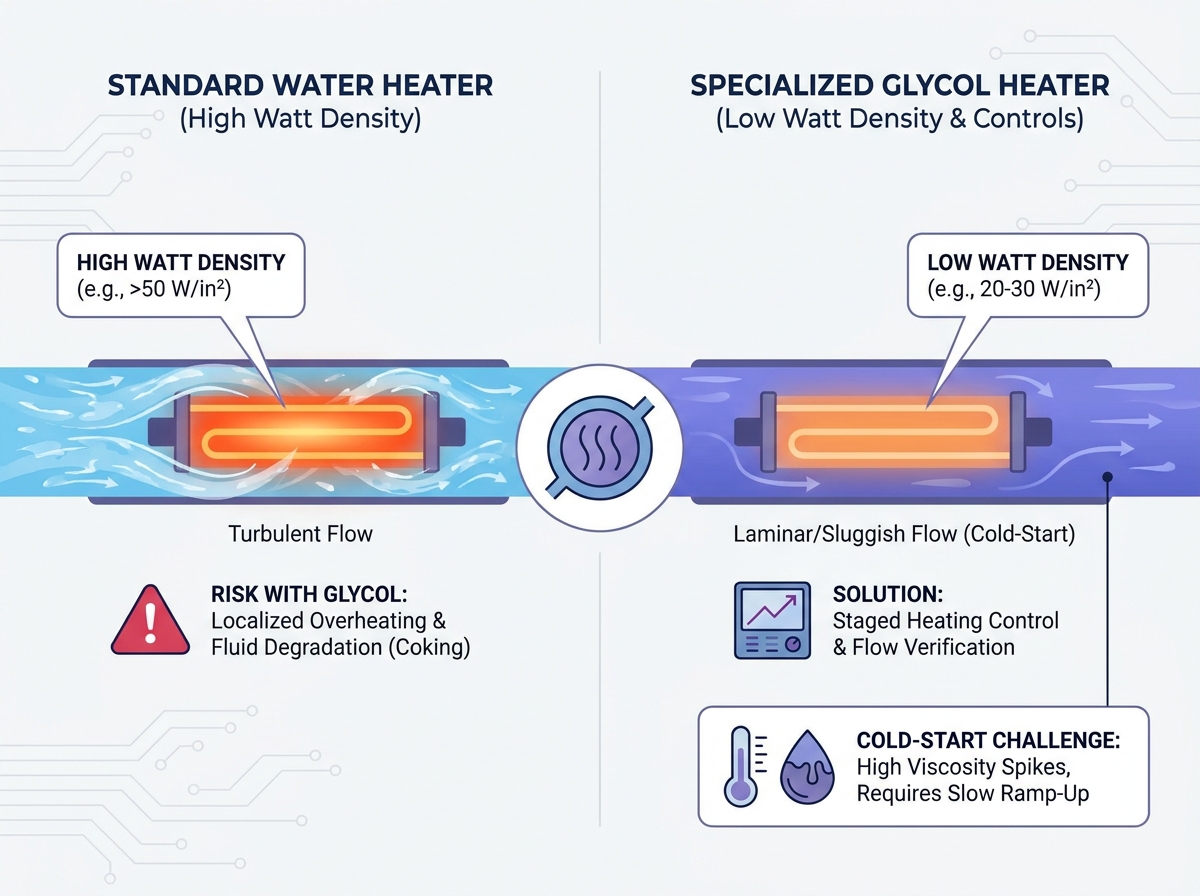
Watt density serves as your most critical evaluation metric. We measure this in watts per square inch (W/in²). Standard water loops handle 60 W/in² easily. Glycol requires much lower watt densities. You should aim for 20 to 30 W/in², depending on the flow rate. Keeping the density low prevents the fluid from boiling. High heat fluxes cause the glycol to scorch right at the element sheath. This scorching creates an insulating carbon layer on the metal. The element then traps its own heat and inevitably fails. Conservative watt density protects both the fluid and the heater.
Internal baffle assemblies also require careful mechanical engineering. Baffles direct the fluid back and forth across the heating elements. They must maintain turbulent flow despite the thicker fluid. Good turbulence ensures the heat moves away from the metal efficiently. Laminar flow creates dangerous heat pools inside the vessel. Engineers space the baffles specifically for the fluid's viscosity. They calculate the expected Reynolds number. Proper baffling prevents dead zones where hot fluid might stagnate and degrade.
| Fluid Property | Pure Water (Standard) | 50% Ethylene Glycol Mix | Impact on Heater Design |
|---|---|---|---|
| Specific Heat | ~1.0 BTU/lb-°F | ~0.85 BTU/lb-°F | Requires higher total wattage for the same temperature rise. |
| Viscosity (at 40°F) | ~1.5 cP | ~15.0 cP | Demands specialized baffles to force turbulent flow. |
| Recommended Watt Density | 60 - 90 W/in² | 20 - 30 W/in² | Needs longer elements or larger vessels to spread the heat. |
| Thermal Conductivity | High | Moderate to Low | Increases the risk of localized film boiling at the sheath. |
Booting up a system in sub-zero temperatures poses immense challenges. The resting glycol becomes thick and syrupy. The pump struggles against this resistance. Flow becomes incredibly sluggish during the initial minutes. Hitting the fluid immediately with full heating power will scorch it instantly. The localized heat cannot dissipate into the sluggish liquid fast enough. The fluid right next to the element flashes and breaks down. This scenario represents the most common cause of winter heater failures. You must manage this startup sequence with extreme care.
Engineers mitigate this danger using advanced control panels. We strongly recommend SCR (Silicon Controlled Rectifier) panels for these applications. You can also use staged step-firing contactors. These mechanisms introduce heat gradually into the heavy liquid. The system fires a fraction of its capacity initially. It warms the local fluid slightly. The pump pushes this warmed fluid forward. Ramping up the temperature slowly drops the fluid's viscosity. The system achieves normal flow velocities before full wattage hits the elements. Proportional integral derivative (PID) controllers manage this delicate ramp-up automatically.
You must also integrate robust flow verification protocols. Relying on temperature sensors alone leaves the system vulnerable. We recommend installing sensitive mechanical or ultrasonic flow switches. Place high-limit temperature sensors directly on the element sheaths. These safety devices interlock with the main heater controls. They ensure the unit cannot fire unless adequate flow actually exists. If the pump cavitates or a valve sticks, the flow switch drops out. The control panel immediately cuts power to the heater. This hard-wired interlock prevents catastrophic element meltdowns during a sluggish cold start.
Proper material selection guarantees operational longevity. Standard copper or basic carbon steel might suffice for pure water loops indoors. However, glycol loops require better corrosion resistance. They also face severe thermal cycling stress during winter months. We typically recommend Incoloy 800 or high-grade 316L stainless steel. These alloys handle the expansion and contraction cycles beautifully. They resist the mildly acidic conditions that occur if the glycol begins to degrade. Selecting the correct alloy prevents pinhole leaks and electrical shorts over the equipment's lifespan.
Cold environments relentlessly steal thermal energy from exposed metal. A bare pressure vessel wastes immense amounts of electricity. You must specify heavy-duty insulation around the heater body. Thick mineral wool or fiberglass works exceptionally well. Manufacturers jacket this insulation in aluminum or stainless steel enclosures. This barrier minimizes conductive heat loss. It keeps the energy directed into the fluid stream. Proper insulation also protects plant personnel from accidental contact burns. It improves the overall thermal efficiency of the entire process loop.
Regulatory compliance protects both your personnel and your equipment. Ensure the heater vessel strictly meets ASME pressure codes. Third-party inspections guarantee the welding integrity under high pressure. If installing the unit outdoors, specify a NEMA 4 enclosure. This rating ensures reliable weather resistance against rain and snow. Facilities dealing with explosive gases have different requirements. They need NEMA 7 housings for hazardous locations. These explosion-proof enclosures contain any internal electrical sparks safely. Never compromise on safety certifications when specifying industrial heating gear.
Finding the right industrial circulation heater requires vetting the manufacturer's engineering rigor. Trustworthy vendors will not simply quote a standard model off a catalog. They will engage in a detailed technical review first. They ask specific questions about your fluid chemistry. They need to know your exact glycol type and concentration percentage. They will request your absolute minimum ambient startup temperature. Avoid suppliers who ignore these variables. A qualified vendor uses thermal modeling software to prove their baffle and watt density selections.
Prepare your system data before requesting a technical consultation. Having this data ready streamlines the engineering process. It prevents expensive miscalculations and project delays. Gather the following information from your plant operations team:
Compile this information into a preliminary specification sheet. Share it with thermal engineering experts. They will design a unit customized for your harsh winter realities. This preparation ensures you procure a reliable, safe heating solution.
A: No. Standard water heaters have high watt densities designed for highly efficient fluids. These concentrated temperatures will scorch thicker glycol mixtures. This leads to immediate fluid degradation, coking, and rapid element failure.
A: While the exact number varies by flow rate and concentration, it generally falls between 20 and 30 W/in². This lower density ensures safe heat transfer without burning the fluid at the element surface.
A: Cold weather drastically increases glycol's viscosity, causing it to become thick and syrupy. This reduces pump flow. Heaters must use staged startup controls to gently warm the fluid and establish flow before applying full power.
A: Yes. Propylene glycol is significantly more viscous than ethylene glycol. It also has different heat transfer characteristics. Using propylene requires specific adjustments to the heater's watt density, surface area, and internal baffle calculations.