E-mail Us: market1@hotoheat.com Call Us On: +86-15366416606

- All
- Product Name
- Product Keyword
- Product Model
- Product Summary
- Product Description
- Multi Field Search
Views: 0 Author: Site Editor Publish Time: 2026-11-15 Origin: Site
Specifying the right temperature sensor represents the core foundation of reliable industrial heating processes. Missing the mark here compromises your entire thermal profile. Production lines suffer noticeably when sensing components read false thermal values. The chosen sensor dictates the exact input architecture of your central panel interface. This singular mechanical choice directly impacts your process accuracy, daily operating cycle times, and fundamental operational safety. A mismatched sensing component forces automated controllers into erratic compensation cycles. It causes heating elements to work excessively hard, aggressively accelerating physical wear on associated power switching mechanisms.
Our comprehensive article delivers an evidence-based comparison of RTDs, thermocouples, and thermistors. We want to empower process engineers and facility managers actively. You will learn to properly make specification decisions based purely on actual process requirements. We reject outdated operational assumptions and generic manufacturer recommendations. Facility teams will finally understand exactly how each distinct sensing device functions under severe industrial stress.
Process yield and overall product quality correlate entirely with steady thermal stability. Facility energy efficiency relies strongly on avoiding minimal wasted heat cycles. Expensive capital equipment lifespan hinges directly on executing smooth operational curves. These crucial success criteria all tie intimately to strict sensor temperature accuracy. Tight control loop response times also depend entirely on highly precise data continuous feeds.
Poor specification parameters create massive and often unseen ongoing operational risks. Improperly mismatched industrial sensors cause dangerous and repeated machinery thermal overshoot. This glaring engineering oversight accelerates rapid and premature primary heater burnout. It subsequently drives up excessive and completely unnecessary factory energy consumption. You must remember the sensing node itself acts simply as a dumb signal data source. True factory operational performance depends heavily on the main logic processing hub. Your heater control panel interprets this weak incoming electrical signal constantly. It masterfully modulates vital heating power via reliable solid-state relays (SSRs) or robust SCR power controllers. Proper calibration alignment between probe and processor ensures optimal mechanical heating cycles. Disconnects here cause intensely erratic heavy power switching physical behaviors. Fast SSR power modulation naturally demands rapid and pristinely clear millivolt inputs.
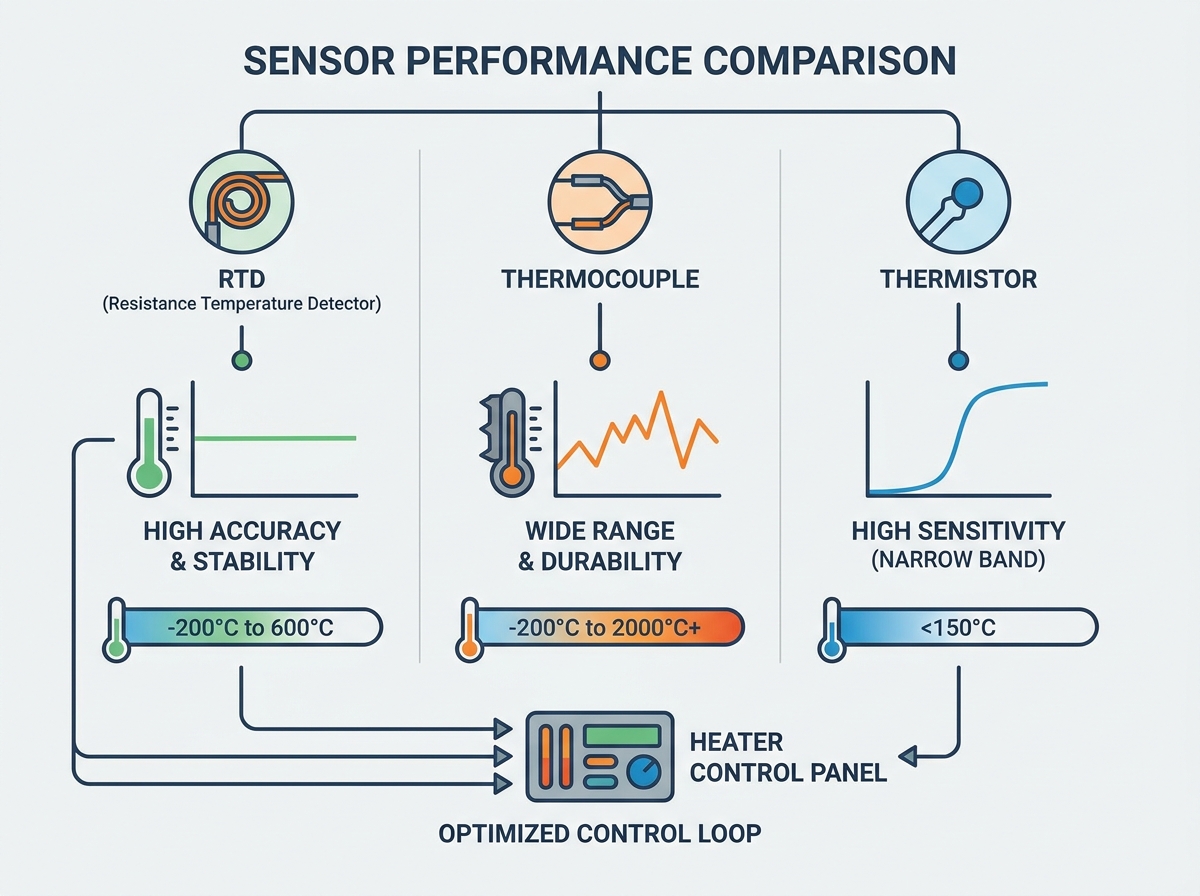
These incredibly rugged devices function natively via the long-established scientific Seebeck effect. They naturally generate measurable electrical millivoltage entirely across two physically dissimilar metal wires. This tiny voltage climbs extremely predictably to continually report ambient local heat shifts. Industry operation teams leverage them deliberately inside extreme process temperatures. They aggressively handle punishing manufacturing environments loosely scaling up to 2000°C seamlessly. Heavy physical mechanical impacts and intense high-vibration manufacturing stages pose little actual threat. Their basic structural rigid integrity successfully handles intense daily industrial abuse easily.
Modern production facilities rely heavily on distinct functional hardware variations. We routinely specify standard Type J wiring architectures frequently. It physically pairs simple iron and constantan metal elements together securely. We find this highly suitable for managing general plastics molding manufacturing operations. Elite manufacturers also vastly prefer Type K probe installations broadly. This upgraded version uses resilient chromel and alumel metal alloys exclusively. This unique metallurgical pairing provides exceptional physical hardware oxidation resistance. It naturally excels remarkably well in much higher continuous stress temperature ranges.
Plant operators continually respect their immediate operational safety advantages. They predictably offer blisteringly fast automated thermal response data times. Heavy rugged construction makes them highly durable continuously day after day. Extremely low component replacement bulk costs make them highly attractive financially for budget-restricted plant operations.
However, engineering maintenance teams must aggressively respect their rigid scientific hardware limitations. Standard industrial thermocouples inherently exhibit notably lower raw base operating accuracy. Typical facility temperature readings quietly wander loosely anywhere between ±1°C and ±2°C randomly. Aggressive ambient facility electrical noise easily corrupts their incredibly weak internal millivolt signals. The primary logic board controller absolutely requires installing dedicated local cold junction compensation. They also inherently drift heavily over vast stretches of deployment time. This unwanted drift forces plant maintenance teams into scheduling distinct sensor replacement routines. Ignoring mandated facility recalibration schedules introduces severe unnoticed operational safety hazards swiftly.
RTDs strictly function by accurately measuring predictable and highly linear changes continually occurring across electrical wiring resistance paths. Most high-performance modern industrial variants utilize pure solid Platinum inner components structurally. Commonly deployed active monitoring models include the highly versatile standard PT100. Many complex modern manufacturing architectures also broadly integrate the finely scaled responsive PT1000. These intensely specific mechanisms perform absolutely flawlessly inside highly critical regulatory applications. We actively deploy them confidently scaling anywhere right between absolute -200°C and blistering +600°C.
Design engineers must carefully and methodically select from distinctly available cabling and structured wiring configurations.
Facility technicians choose precise RTDs primarily simply because they instantly offer exceptional incoming data linearity. You enjoy deeply stunning and totally dependable operating accuracy continually. You can safely monitor minute hidden fractions of a single fluctuating degree reliably. The solid stationary internal wiring structures remain highly mechanically stable. They easily endure many grinding years of incredibly constant operation. They physically cause virtually zero unexplainable spontaneous thermal sensor drift.
Yet, seasoned plant operational managers genuinely face undeniable physical field trade-offs here constantly. You will correctly notice a considerably much slower thermal reaction response time generally. Their visibly greater rigid structural mass actively slows natural ambient external heat absorption somewhat. Procuring them widely requires a significantly noticeably steeper initial upfront capital financial investment. Blunt mechanical line shock naturally poses a highly serious and totally constant threat. Harsh unexpected impacts easily instantly shatter the highly delicate internal brittle ceramic structural resistance elements.
Thermistors inherently rely heavily on highly specialized manufactured ceramic or complex synthesized polymer internal resistors. We usually safely specify highly specific modern NTC components for everyday broad industrial machine setups. NTC translates simply straight out to mean a "Negative Temperature Coefficient." These advanced sensitive resistors effectively offer huge massive internal voltage electrical resistance operating changes. They aggressively shift wildly rapidly relative to incredibly seemingly minor tiny disturbances in exact local ambient heat.
They reliably deliver totally and completely unmatched localized targeted detection sensitivity. They physically perform brilliantly flawlessly strictly inside their carefully scientifically specified intended thermal operating range. Operators greatly appreciate the incredibly surprisingly fast rapid analog response feedback dynamics. Their exceptionally dirt-low total unit procurement cost directly benefits massive bulk OEM factory productions heavily. Diverse high-volume heating commercial appliance assembly applications easily leverage them continually heavily for deep bottom-line cost bulk savings.
Unfortunately, they always natively output a highly weirdly jagged and difficult non-linear voltage signal pattern. Properly programming basic standard industrial logic controllers correctly to systematically linearize this weird raw data requires very intense configuration effort. You must always restrict their factory deployment strictly down to distinctively lower operational thermal operating windows. We safely rarely ever deploy raw thermistors anywhere significantly functioning above 150°C properly safely. Carelessly overheating their brittle fragile core structure permanently decouples their deeply vital precision output internal calibration. Experiencing sudden excessive raw thermal heat spikes actively destroys the specific internal sensing wire element almost instantaneously.
Different demanding extreme manufacturing processing environments correctly demand completely different specialized sensing instrumentation approaches. We carefully built highly solid reliable evaluation structural guidelines heavily detailed below. We genuinely want to completely actively streamline your highly complex factory sensor parts procurement equipment strategies.
You should confidently choose heavy-duty rugged thermocouples rapidly when dealing primarily intensely in extreme brutal heavy raw industry. Large operating foundry furnaces and hot brick baking kilns continually lean heavily actively on this profoundly rugged physical technology. Dirty industrial operational applications demanding relentless pure basic physical machine durability deeply need basic thermocouples instantly. Extremely high constant operating production temperatures correctly trump desiring fractional-degree precise accuracy strongly in these specific brutal heavy structural scenarios.
You must quickly choose highly stable specialized RTDs proactively for demanding high-stakes modern regulatory clean facility operational environments. Expansive sanitary food and wet beverage processing lines continually necessitates very profoundly strict daily thermal tracking rules. Extremely modern medical pharmaceuticals and highly volatile bubbling chemical batch reactors actively depend entirely structurally on this rigid exact reliability tracking profile. Any complex demanding factory system rigidly mandates making this specific choice instantly when pure long-term operational stability truly matters. Delivering incredibly precise, highly repeatable continuous heater temperature and power control proves absolutely mechanically critical for meeting highly strict ongoing regulatory agency compliance audits.
You may quickly choose highly sensitive fragile thermistors specifically for widespread consumer commercial appliance generic assembly product lines. Complex expansive generic facility building HVAC air systems utilize them effectively continually tucked everywhere unseen. Specialized critical heated medical procedural device physical heating warming assemblies correctly rely extensively actively on their immediate rapid accurate thermal device feedback capabilities. You can utilize them extremely perfectly smoothly for strictly programming highly specific sudden fast safety-limit thermal cutoffs. They actively naturally excel exceptionally beautifully well operating inside very uniquely narrow medical or appliance device thermal testing specification bands.
Table: Quick Sensor Selection Guide
| Sensor Type | Optimal Temperature Range | Primary Functional Strength | Critical Known Limitation |
|---|---|---|---|
| Thermocouple | 0°C scaling to well over 2000°C | Extreme brutal physical durability and remarkably fast response time | Inherent gradual shifting baseline output signal drift |
| RTD (PT100/PT1000) | Strictly -200°C precisely to 600°C | Unmatched fractional-degree reading accuracy and long-term signal stability | Noticeably slower response time and much higher initial unit cost |
| Thermistor (NTC) | Safely strictly functioning under 150°C | Massive huge tracking sensitivity at a very bare minimal unit cost | Produces a highly difficult non-linear jagged data output curve |
Intensely busy modern industrial factory concrete floors routinely generate extremely severe rampant ambient local electrical facility noise. Running continuously operating automated facilities actively experience incredibly rampant invisible EMI and highly random damaging RFI data signal wiring degradation constantly. Delicate weak baseline thermocouple raw millivolt electrical signals become highly instantly susceptible to capturing this ambient electrical noise. Massive variable frequency motor drives (VFDs) and heavy snapping magnetic circuit contactors routinely effortlessly drown entirely out these weak fragile basic sensor tracking feeds. You absolutely must heavily properly install highly rated high-grade thickly shielded data extension running wire comprehensively firmly during initial machine integration. Implementing proper strict separate metal electrical conduit separation prevents observing phantom ghost temperature tracking spikes extremely effectively.
Modern internal logic controller hardware compatibility continually presents a very surprisingly frequent confusing stumbling technical block today. Your central core machine logic processing unit must solidly align smoothly both mechanically technically and digitally compatibly right now. Ensure firmly your highly advanced fast PID smart controllers or massive PLCs naturally feature handling the exact correct universal open sensor inputs natively directly. Older aging legacy production facilities often broadly utilize highly uniquely specific modular expansion slot cards completely instead totally. These extra addon insertable cards must firmly match handling the exact chosen distinct physical sensor input data profile perfectly. Mistakenly incorrectly connecting highly sensitive raw PT100 output inputs improperly directly to a basic simple Type K module actively causes massive immediate catastrophic internal system logical failure.
Ignoring uncompensated heavy copper lead wire distance electrical resistance silently acts exactly as a completely hidden silent massive factory efficiency power killer. Incorrectly blindly using simple standard basic bare copper wiring incorrectly naturally creates an entirely separate brand new phantom physical thermal junction spot on active thermocouples. Failing totally blindly to utilize proper fully shielded 3-wire RTDs securely for exceedingly long spanning facility cable ceiling pipe runs actively introduces massive severe hidden data reporting inaccuracies. Excessive total continuous wire pull length severely adds huge phantom unintended voltage electrical resistance. It completely actively compromises the raw vital physical input signal data rapidly long before local processing logic even attempts to begin.
Let confirming your exact required total maximum machine operating temperature securely dictate picking your primary overarching heavy sensor equipment category initially. Analyzing your highly specific rigid required exact thermal reporting tolerance control levels correctly will smoothly narrow predicting the exact final hardware model equipment variant down much further. Only carefully confidently then should you actively heavily design detailing the significantly larger mechanical feedback control automated loop strictly completely around it. Your immediate highly suggested urgent next vital step actively involves properly heavily auditing actively checking your current rigid thermal process manufacturing tolerances extremely thoroughly. Consult effectively quickly and deeply proactively immediately right now with a highly skilled trained industrial panel logic builder expert. Verify cleanly ensuring your highly sensitive running PID smart controllers remain smoothly fully strictly optimized today. Ensure cleanly that your highly robust massive power electrical switching SCR components solidly seamlessly align absolutely perfectly operating heavily correctly for executing your newly chosen exact sensitive sensor hardware framework.
A: Not directly. The PID controller must be completely reprogrammed or manually physically reconfigured via distinct dip switches and specific specialized input component cards. Your panel logic motherboard must actively accept reading a standard resistance signal smoothly instead of a typical raw millivolt voltage signal. Furthermore, floor operators must thoroughly completely upgrade all underlying connecting wire cabling architectures safely completely to firmly actively support carrying the newly swapped sophisticated RTD physical structure securely natively.
A: Enduring prolonged constant physical exposure handling intense high extreme heat creates intense continuous progressive metallurgical structure changes happening deep within the outer protecting sensor probe housing. Sustaining harsh corrosive toxic industrial atmospheric conditions actively steadily degrade deteriorating the internal core reading alloys further. This unavoidable heavy physical deterioration inevitably forcefully alters the vital baseline core voltage data output signal continually heavily. You basically must methodically perform completely regular maintenance calibration measurement sweeps or aggressively schedule triggering a full unit replacement safely securely maintaining strict operational accurate safety feedback.
A: Utilizing exposed-junction basic bare thermocouples easily continuously provide ensuring the absolute quickest fastest thermal reaction feedback checking paths broadly available physically today. Properly utilizing small-bead delicate fragile thermistors also heavily offer incredibly extremely fast reaction response tracking times operating securely safely strictly under 150°C. Conversely however, heavy thick armored RTDs react noticeably heavily slower physically. Their heavy thick protective coating sheathing protecting housing and considerably substantially larger overall solid thermal core mass natively strongly impede handling rapid fast flash heat transfer deeply directly reaching into the embedded internal sensing apparatus.
A: Yes completely. Basic thermocouples essentially strictly absolutely require installing highly specific specialized extension pull wire properly strictly completely manufactured precisely directly from utilizing the exact identical same core metal raw alloys forming exactly as constructing the sensor probe itself internally natively physically. RTDs actually successfully smoothly function extremely perfectly well effectively utilizing standard generic industrial copper wire safely. However importantly, installation line technicians must always tightly neatly implement specialized heavily twisted 3-wire or complete 4-wire hardware configurations systematically completely intentionally systematically correctly actively cleanly naturally canceling nullifying washing out destroying the natural voltage electrical resistance normally found physically manifesting heavily creeping smoothly inside long reaching cable plant distance runs.