E-mail Us: market1@hotoheat.com Call Us On: +86-15366416606

- All
- Product Name
- Product Keyword
- Product Model
- Product Summary
- Product Description
- Multi Field Search
Views: 0 Author: Site Editor Publish Time: 2026-11-22 Origin: Site
When an industrial immersion heater fails unexpectedly, facilities often scramble to minimize costly operational downtime. The immediate priority is getting the thermal process back online quickly. Plant managers feel intense pressure to restore full production capacity. However, rushing to order a direct unit replacement frequently leads to recurring failures down the line. Replacing a heater is rarely just a simple part-number swap.
Industrial process conditions, fluid viscosities, and specific operational demands usually shift significantly since the original installation. Ignoring these process changes guarantees you will inherit the exact same design flaws. This article serves as a comprehensive technical evaluation guide. It helps maintenance engineers and procurement teams thoroughly assess system requirements before purchasing. You will learn how to verify critical dimensions accurately. We will help you ensure strict process compatibility for various industrial fluids. Ultimately, you will discover how to select an upgraded replacement design. Making the right choice directly improves your system's long-term reliability.
Many maintenance teams default to ordering the exact same part number when a system goes down. They view this direct swap as the safest route. They also believe it provides the fastest way to restore production. Unfortunately, this approach carries severe hidden costs. Suppose the original unit suffered from coking, scaling, or rapid corrosion. Buying an identical unit ignores the underlying physical problem entirely. A direct replacement inevitably suffers the exact same fate. You are simply purchasing a future system failure.
To prevent this cycle, you must conduct a thorough root cause evaluation first. Pull the failed heater from the vessel carefully. Inspect the unit closely for physical damage. Visual indicators provide vital clues about hidden system imbalances. Look for specific failure modes on the equipment surface. Heavy white calcification points directly to mismatched watt density for the water quality. Split or ruptured sheaths strongly indicate incorrect material selection for the chemical environment. Blackened, carbonized buildup suggests severe fluid degradation. This degradation usually results from excessive surface temperatures.
We define a successful replacement as one doing more than just fitting the existing mounting hole. It needs to significantly extend your system's mean time between failures (MTBF). You achieve this critical goal through optimized technical specifications. Engineers must evaluate current fluid properties constantly. Process temperatures often change over years of active production. Chemical concentrations drift far from original baseline designs. By adapting the new heater to these modern realities, you protect your equipment investment completely.
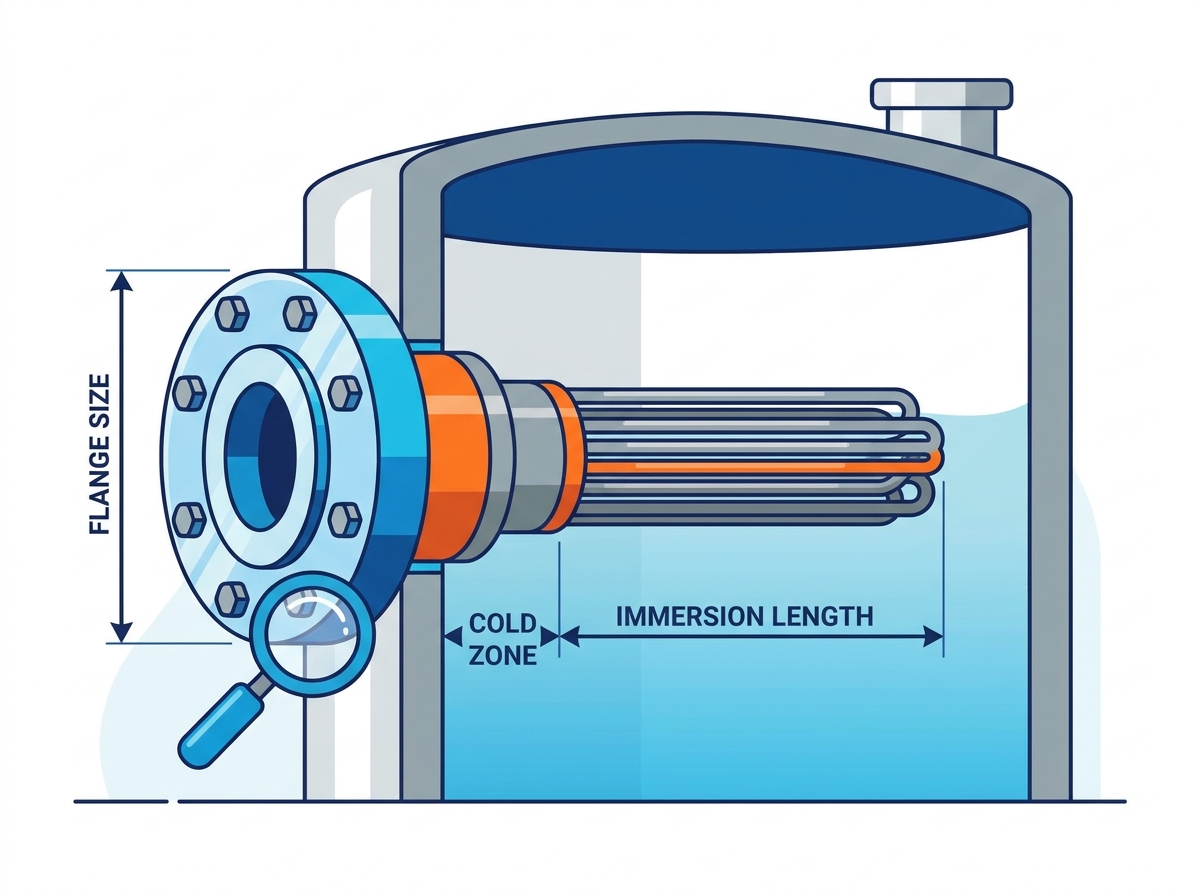
To prevent catastrophic installation errors, operators must verify physical measurements precisely. When installing a new flanged electric heater, accuracy ensures optimal thermal performance. You cannot rely solely on outdated blueprints. You also should never trust old purchase orders implicitly. Always measure the actual tank geometry in its current physical state. Facility modifications often alter vessel dimensions significantly over time.
Follow these essential measurement steps to validate your replacement unit specifications:
Matching the heater specifications to the process fluid prevents premature breakdowns. The most critical operational factor remains the unit's watt density. We measure this thermal output formally in watts per square inch (W/in²). You must carefully balance the heat output against the fluid's physical ability to absorb it.
Clean water typically handles higher watt densities quite smoothly. You can safely use 45 to 60 W/in² for most municipal water heating applications. However, viscous industrial liquids behave entirely differently. Viscous oils or heavy glycol mixtures require extremely low watt densities. They need restrictive ranges between 10 and 20 W/in² to operate safely. High localized heat causes immediate chemical fluid degradation. Industry professionals call this severe breakdown process coking. Coking forms a solid, carbon-based insulating layer right over the heating elements. This hardened barrier traps internal heat and destroys the unit rapidly.
Next, you must select the correct metallic sheath material. Different industrial fluids demand highly specific metal alloys for safe operation. Choosing incorrect metallurgy guarantees rapid corrosion. It also causes severe downstream system contamination. Review the comprehensive material matrix below to guide your engineering choice.
Table: Recommended Sheath Materials for Industrial Fluids| Sheath Material | Target Fluid Application | Common Operational Scenarios | Corrosion Resistance Level |
|---|---|---|---|
| Copper | Clean Water | Domestic water heating, freeze protection. | Low (Non-corrosive environments only) |
| Incoloy® 800/840 | Mild Corrosives & High-Temp | Process water heating, mild chemical solutions. | Medium to High |
| 316 Stainless Steel | Harsh Chemicals & Solvents | Industrial degreasing solutions, food processing. | High |
| Titanium | Severe Corrosives & Salts | Seawater warming, highly acidic chemical baths. | Extreme |
Finally, consider the actual fluid velocity moving across the elements. Proper flow rates improve heat transfer efficiency immensely. Stagnant fluids cause dangerous localized overheating within the vessel structure. In low-flow environments, mechanical engineers might require custom element bending profiles. Sometimes they add structural internal baffling directly to the heater bundle. These baffles force the fluid to weave intricately over the hot elements. This induced turbulence maximizes heat absorption securely. It keeps surface temperatures well within safe operational limits.
Large industrial vessels present highly unique thermal distribution challenges. When sizing flanged heaters for storage tanks, external environmental conditions dictate your primary design choices. These massive units often operate entirely outdoors. They also frequently sit in harsh industrial washdown zones. Therefore, selecting the absolutely correct terminal enclosure prevents devastating electrical failures.
Evaluate terminal enclosure ratings based strictly on the current installation environment. We rely heavily on standard NEMA classifications to guide these crucial safety decisions:
Regulatory compliance ensures both operational safety and essential legal protection. For closed, pressurized vessels, you must always verify ASME Section VIII certification. This rigorous standard guarantees the flange geometry remains sound. It ensures structural welding can withstand intense system pressures safely. Certification involves strict hydrostatic testing protocols at the manufacturing factory.
Additionally, always demand UL or CSA listings for the entire electrical assembly. Skipping these critical certifications exposes your facility to immense liability in the event of an accident. Uncertified equipment often invalidates commercial insurance policies instantly. Always document this strict compliance clearly during the initial procurement phase. Keep these certificates on file for all future safety audits.
Off-the-shelf heaters rarely meet the exact technical specifications of older industrial systems. Legacy equipment often features highly unique mounting arrangements. They also frequently utilize unusual power constraints or voltages. Standard catalog items usually fall short in these complex field scenarios. Therefore, industrial buyers must look far beyond the initial unit price when making a selection.
Evaluate your manufacturing partners based heavily on their deep technical capabilities. The best vendors provide detailed thermal calculations before any manufacturing begins. They mathematically prove the thermal design will actually work. They can also reverse-engineer obsolete parts effectively when original drawings go missing. Securing reliable custom heater engineering and support ensures you get a perfect physical and electrical fit. Dedicated vendors optimize the replacement unit specifically for your current process demands. They avoid relying on outdated, risky assumptions.
Working with engineering-focused vendors mitigates numerous complicated project risks. It drastically reduces expensive specification errors prior to metal fabrication. They ensure proper electrical integration with your existing facility control panels. They verify exact compatibility with your current temperature sensors. These sensors include standard thermocouples or precise RTDs. Often, they help determine optimal sensor placement. They decide if sensors should sit directly on the element sheath or safely inside a protective thermowell.
Furthermore, strong engineering partners provide much more reliable production lead times. This crucial operational transparency helps maintenance teams schedule facility downtime accurately. Predictable delivery schedules prevent extended, costly process outages. When vendors understand the mechanical engineering deeply, they manufacture the unit correctly the first time. You completely avoid the absolute nightmare of receiving a custom unit refusing to fit the vessel nozzle.
Replacing an industrial immersion heater demands careful attention to technical detail. It requires a rigorous check of physical dimensions. It also requires strict fluid compatibility verification and environmental safety standards adherence. You should treat every replacement event as a strategic opportunity for a system upgrade.
Consider these actionable next steps to ensure complete project success:
Complete these critical steps before issuing any final purchase order. Proper upfront preparation eliminates repetitive equipment failures. It maximizes your operational uptime efficiently and keeps your facility running safely.
A: Measure directly from the inside face of the mounting flange to the very tip of the longest heating element. Do not include the terminal housing or the exterior flange thickness in this measurement. This strict dimension ensures the element bundle fits perfectly within your tank's spatial limits without striking the opposite wall.
A: You can only increase wattage if the tank's electrical infrastructure can handle the increased load. You must verify your facility's amperage capacity, wire gauges, and control contactors first. Additionally, ensure the resulting watt density does not exceed the specific fluid's maximum allowable limits, which causes rapid coking or fluid burning.
A: The most common causes include mineral buildup, known as scaling. This buildup creates rigid insulation and causes rapid element overheating. Operating the heater in the open air due to extremely low liquid levels also destroys elements quickly. Finally, using a watt density too high for the specific viscous fluid breaks down the protective sheath material.
A: You must consult your facility's formal hazardous area classification documentation. Suppose the electric heater operates anywhere in a Class I, Division 1 or 2 environment. Flammable gases or combustible vapors exist there continuously or periodically. In this case, a NEMA 7 enclosure is legally and operationally required to prevent catastrophic atmospheric ignition.